| 2017 Chinese public building decoration (curtain wall) market size and development forecast |
| Publisher:admin Click:2162 |
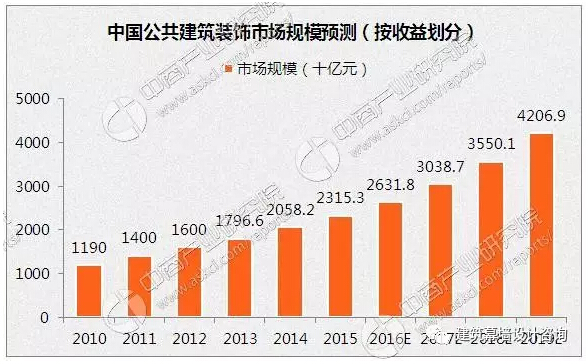
In 2015, China's public building decoration (curtain wall) market size accounted for more than 59.6% of the entire building decoration market, including office buildings, hotel buildings, government buildings and transport buildings, including non-residential building decoration. Since 2010, the market scale of public building decoration in China has increased at a compound annual growth rate of 14.2% to reach RMB2,315.3 billion in 2015. Since the government has increased investment in transportation (subway, high speed railway, etc.) The construction of medical buildings (such as hospitals) and the continued development of the commercial real estate sector is estimated to amount to $ 4,206.9 billion in 2019. Now in schools, hospitals, pension building and other fields, the use of curtain wall by the larger restrictions.
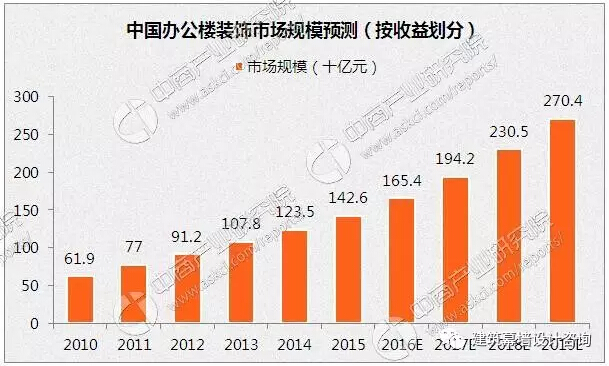
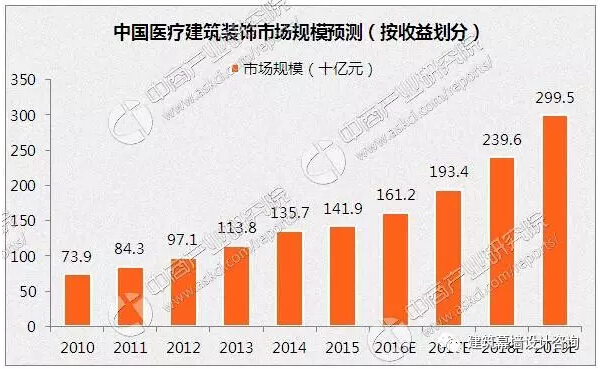
Since 2010, China Medical Building Decoration Division of the market size of the compound annual growth rate of 13.9% growth in 2015 reached 141.9 billion yuan. With the rapid development of China's medical industry and the growing awareness of the health of the people, China (especially the second and third tier cities) will establish more hospitals, community clinics and maternal and child health care centers and other medical facilities, in 2015, medical building decoration industry in China Public building decoration market share of 6.1%, and its share is expected in 2019 to 7.1%. Since 2010, the size of the office decoration market by the compound annual growth rate of 18.2% growth in the size of the market in 2015 to 142.6 billion yuan, accounting for medical building decoration market outside the overall public building decoration market 6.2%. First-tier cities, such as Beijing and Shanghai, maintain a large demand for office space, but vacancy rates in second-tier cities such as Suzhou, Hangzhou, Nanjing and Wuhan are still high as economic growth reverses, and further stimulus needs for third- and fourth- Line city office building needs. Estimated from 2016 to 2019 of the office building decoration market compound annual growth rate of 17.8% to 2019 market size of 270.4 billion yuan. Since 2010, the scale of commercial building decoration market by compound annual growth rate of 15.9% growth in 2015, the market size of 410.4 billion yuan. However, the rise in e-commerce has had an impact on the development of commercial buildings such as shopping centers and supermarkets, and the average annual growth rate is estimated to be 13.7% between 2015 and 2016. To cope with the slowdown in business growth, a number of commercial building developers tend to participate in more service-related businesses such as restaurants, cinemas and other recreational facilities. The annual growth rate of commercial building decoration market is expected to reach 19.0% in 2018. It is expected that since 2016, the scale of commercial building decoration market will grow at a compound annual growth rate of 18.2%, to 2019 the market scale of 770.3 billion yuan. According to Frost & Sullivan report, China's public building decoration curtain wall market development is mainly driven by the following factors: Government support and investment. According to the 12th Five-year Plan for National Economic and Social Development of the Building Decoration Industry, the Chinese government has set a target output value of RMB 2.6 trillion for the public building decoration market by 2015, and the annual growth rate during the 12th Five- Was 18.9%. To this end, the Chinese government introduced policies to support the industry. The Chinese government is also expected to increase investment in fixed assets in the coming year to boost infrastructure construction and real estate development, the number of new projects, expansion projects and reconstruction projects. These investments will bring great demand for Chinese architectural decoration services. Urbanization process accelerated. The process of urbanization accelerates the investment in fixed assets, stimulates the development of public infrastructure, and gradually increases the demand for decoration. In 2015, 56.1% of China's total population lives in urban areas, compared to 50.0% in 2010. The increase in population in urban areas further stimulates demand for new housing and public facilities such as supermarkets, hospitals and schools which are to be renovated before use. It is estimated that in the next five years, the new housing gap from rural areas will reach 3 billion square meters. At the same time, it is estimated that the demand for public facilities will reach 1 billion square meters, including shopping centers, office buildings and recreational facilities. Commercial, office and residential real estate developers and rough residential property of the final buyer in the property before the use of decoration services are required. Due to the accelerated pace of urbanization, the increasing demand for various types of property will lay a solid foundation for the development of public building decoration market and bring huge market development potential for architectural decoration service suppliers (such as the Company). Economic Growth. China's GDP grew rapidly, with a compound annual growth rate of 10.6% between 2010 and 2015, benefiting from a series of economic stimulus measures adopted by the Chinese government, including the RMB4 trillion stimulus package and the ten industrial revitalization plans. Despite the slowdown in growth rates since 2014, China's GDP is expected to recover and recover at a compound annual growth rate of 6.4% for the period 2015 to 2020, as consumption patterns shift and the economy escalates . In April 2015, the State Council approved the infrastructure and utility franchise management approach to simplify the approval process to attract private enterprises to invest in infrastructure and utilities to create further demand for construction and renovation of the project. China's economic recovery and new private capital driving the building decoration market, thereby further promoting the building decoration industry, improve the investment environment and promote the development of the Chinese market. Increase in disposable income. Per capita disposable income of urban residents increased from RMB19,110 in 2010 to RMB31,200 in 2015, with a compound annual growth rate of 10.3%. In view of China's solid economic outlook, the index is expected to continue to rise and reach RMB 49,470 in 2020, a CAGR of 9.7%. The increase in disposable income will stimulate the Chinese people to improve living conditions and increase the housing and office decoration and design costs will. The Development of Modern Service Industry. The growth of the Chinese economy has led to the development of modern service industries (including tourism, catering and exhibition industries), driving an increasing number of hotels, exhibition centers and other related infrastructure. Implementation of these projects will not only promote the development of the public building decoration market, but also the quality and fineness of building decoration put forward higher requirements. Cultural and health needs. As living standards improve, the cultural and health needs of people's daily lives become more prominent, and the demand for related infrastructure, including cultural centers, public libraries, museums, hospitals, clinics and other medical institutions, continues to rise. The construction of these public infrastructures will certainly bring new momentum to public building decoration. The Main Market Trends of China 's Public Building Decoration (Curtain Wall) Market According to Frost & Sullivan report, China's public building decoration market trends are as follows: More standardized regulation. As the public building decoration industry tends to mature, the Government will continue to monitor the operation of the market and the industry will be more standardized regulation. Unlicensed operation of the decoration business will be reduced and will eventually be banned. Horizontal expansion of business. As business operations continue to expand, a large number of public building decoration participants will expand its business in the application-related areas of business. International development. A growing number of public building decoration industry participants are committed to winning overseas projects to expand their business. In addition, the establishment of strategic relationships with overseas real estate developers will also help public building decoration companies to go abroad. More attention to environmental protection. In response to the rising demand for environmental protection in the public building decoration industry and the idea of "green", energy conservation and environmental protection have become increasingly important factors in the development of decoration design, construction technology and the selection of decorative materials. Project Spare. Provision of project funds (limited use of funds such as emergency procurement of special and piecemeal raw materials and temporary employment and payment of other special and miscellaneous expenses) to the project manager in the course of the execution of the construction project is the industry practice of the public building decoration industry in the PRC, The practice has also been adopted by other leading industry participants such as Suzhou Gold Mantis Construction & Decoration Co., Ltd. ("Suzhou Golden Mantis") and Zhejiang Yasha Decoration Co., Ltd. ("Asia Ha"). The Challenges of Chinese Public Building Decoration Market China's public building decoration industry is still in the early stages of development and the market inevitably lack of industry participants to comply with and comply with the perfect standards and mechanisms. China's public building decoration market is highly fragmented and regionalized, with most of the industry participants being small players known to have qualifications and licenses, construction quality and operational management issues. Leading players in the industry should lay the foundations for the implementation of quality projects and help develop market standards to achieve industry consolidation and the gradual reduction and elimination of underperforming participants. |
| Pre:Business increased 1.5% corporate tax burden does not fall instead of the State Administration of Taxation will be symptomatic moves |
  |